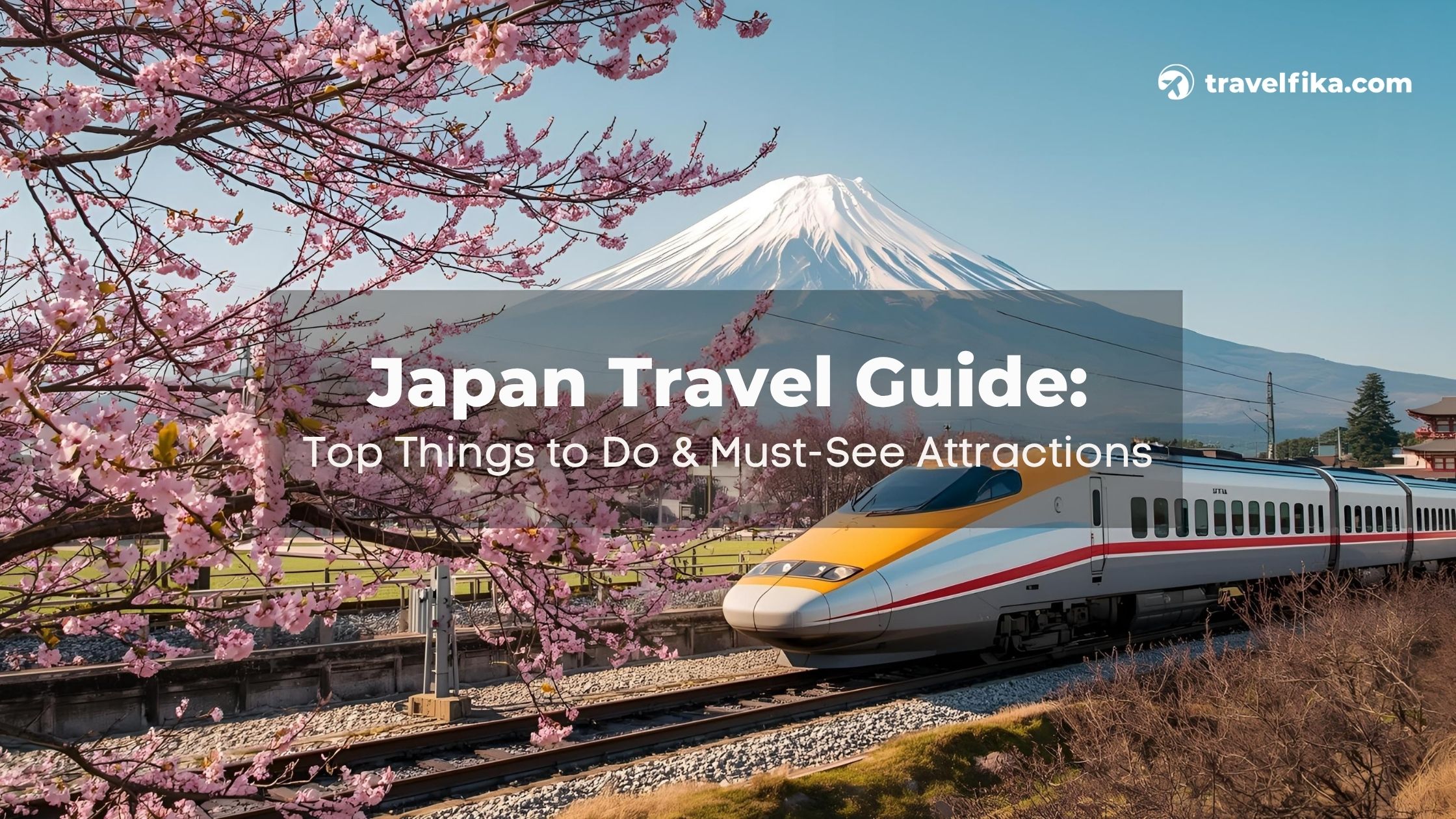
Japan Travel Guide: Top Things to Do & Must-See Attractions
Japan Travel Guide: Top Things to Do & Must-See Attractions
5 min read
We've landed at Narita bleary-eyed, missed the last train in Osaka and had to walk back through streets that still smelled of takoyaki grease and cigarette smoke, and stood at a Shinto shrine in January cold so sharp it made our ears hurt. And still, every single one of us would go back tomorrow. This Japan travel guide isn't neutral and it doesn't hand out participation trophies. We're going to tell you what's genuinely worth your time and what you can skip without guilt. Japan rewards preparation and punishes vague plans. So let's get into it.
The Cultural Stuff That Actually Gets Under Your Skin
Kyoto is the obvious starting point, and yes, it deserves the hype, but only if you get there before the tour buses do. We were at Kiyomizu-dera Temple by 7am once, and the light coming through the cedar scaffolding with mist still sitting in the valley below is something none of us have been able to properly describe to anyone back home. It's a UNESCO World Heritage site, but more than that, it's alive in a way that makes you walk slower and talk quieter without anyone asking you to.
The Arashiyama Bamboo Grove is real and it is genuinely eerie and beautiful. It is also packed by 10am, so either go at sunrise or accept you're sharing the moment with a hundred selfie sticks. Go at sunrise, then reward yourself with yudofu, the tofu hot pot, at one of the riverside restaurants while the rest of the tourists are still at breakfast. In the evening, wander Gion with zero agenda. The chances of spotting a geisha rushing between appointments are better than you'd think, and the whole district feels like someone forgot to turn the 21st century on. If you want to dig deeper into the food side of things, the curated Kyoto food tours are genuinely worth the money. We did one, ate things we couldn't name, and have been chasing that level of meal quality ever since.
Tokyo's Meiji Jingu is the spiritual counterweight to everything Tokyo throws at you. You walk through a towering torii gate and the city just drops away. Wash your hands at the temizuya before you go further. It's not just ritual. It actually makes you slow down and show up properly. The shrine is dedicated to Emperor Meiji and Empress Shoken, and the forest around it was entirely planted by human hands, which somehow makes it feel more meaningful, not less.
Japan Travel: Real Questions, Actual Answers
When is the best time to visit Japan?
Spring and autumn are the best times, full stop. Late March through early May brings cherry blossoms and the whole country holds its breath in the best possible way, but it's peak season, so book accommodation months ahead, not weeks. Autumn, October through November, is our team's personal favorite: maple foliage is spectacular, the humidity has backed off, and the summer crowds are gone. Avoid July and August if you can — the heat and humidity are real enough to ruin the trip.
How many days do you actually need in Japan?
For a first visit covering Tokyo, Kyoto, and Osaka, you want 10 to 14 days minimum — push toward 14 if your schedule allows. Less than 10 days and you'll spend half the trip on trains catching up with yourself. Adding Hiroshima, Hakone, or Nara means building in extra days rather than rushing. Japan rewards slowing down, and the best moments happen when you have time to be surprised.
Is Japan as expensive as people say?
Not if you move through it smartly. Accommodation and long-distance transport are where costs stack up, but the JR Pass handles the Shinkansen bill. Beyond that, a bowl of ramen from a proper shop runs 900 to 1,200 yen. Japanese convenience store food — genuinely good, not what you're imagining — costs a few hundred yen. The trap is assuming Japan requires a luxury budget. It doesn't, unless you want it to.
Do I need a visa to visit Japan?
Most Western nationalities can enter Japan visa-free for up to 90 days, including travelers from the US, UK, Canada, Australia, and most of Europe. That said, entry requirements have been updated in recent years. Always check the official Japanese Embassy or consulate website for your specific passport before booking. Do not rely on what a friend told you six months ago.
What experiences in Japan are actually unmissable?
If you press us on it:
Ride the Shinkansen at least once — it's one of the great travel experiences on earth
Your Key to Effortless Travel
Meet Travelfika
Planning a trip should be exciting, not exhausting—and that's where Travelfika comes in! With our smart AI-powered tools, insider tips, and seamless planning features, we make travel easier than ever.
Whether you're crafting the perfect itinerary, discovering hidden spots, or getting real-time recommendations, Travelfika has your back. No more endless research or last-minute stress—just smooth, effortless travel planning tailored to you. So go ahead, dream big, explore more, and let Travelfika handle Read More
Planning a trip should be exciting, not exhausting—and that's where Travelfika comes in! With our smart AI-powered tools, insider tips, and seamless planning features, we make travel easier than ever.
Whether you're crafting the perfect itinerary, discovering hidden spots, or getting real-time recommendations, Travelfika has your back. No more endless research—just smooth, effortless travel planning tailored to you.Read More
Planning a trip should be exciting, not exhausting—and that's where Travelfika comes in! With our smart AI-powered tools, insider tips, and seamless planning features, we make travel easier than ever.
Whether you're crafting the perfect itinerary, discovering hidden spots, or getting real-time recommendations, Travelfika has your back.Read More
Planning a trip should be exciting, not exhausting—and that's where Travelfika comes in! With our smart AI-powered tools, insider tips, and seamless planning features, we make travel easier than ever. Read More
Planning a trip should be exciting, not exhausting— and that's where Travelfika comes in! With our smart AI-powered tools, insider tips, and seamless planning features. Read More
If you're going to do one cultural activity you'll talk about for years, do a proper tea ceremony. Not the tourist-facing, fifteen-minutes-and-a-photo version, but a sitting that takes an hour and makes you realize how little stillness you ever allow yourself. A calligraphy class, shodo, runs a close second. Our hands were a disaster. The instructor was incredibly kind about it.
Kimono rentals are widely available in both Kyoto and Tokyo, and we'll be honest: we were skeptical. Then one of our team spent an afternoon walking through Higashiyama in a deep indigo kimono and the wooden sandals called geta and reported back that it was the best decision of the trip. Just factor in that geta are genuinely difficult to walk in for long distances.
Eating in Japan: Where the Real Religion Is
We stuffed ourselves on ramen for about 900 yen a bowl, which for context is less than a vending machine coffee at an airport back home. Every region has its own version and they will all tell you theirs is the best. Kyushu's tonkotsu is a pork bone broth so rich it almost feels like a meal and a dessert at once. Hokkaido's miso ramen tastes like someone made comfort food for very cold, very serious people. We did a semi-accidental ramen crawl in Fukuoka once, hitting three different shops in one afternoon. No regrets. Zero.
Sushi in Japan is not the same food as sushi anywhere else. We're sorry, but it's true. For the full experience, the Toyosu Fish Market, which took over from the old Tsukiji as the city's main wholesale market, lets you watch the famous tuna auction if you register early enough. Standing in that refrigerated hall at 5am watching a single bluefin tuna sell for more money than our entire trip budget was one of the more surreal things we've collectively witnessed.
Osaka is where you eat yourself into a genuine crisis of joy. The Dotonbori district at night looks like someone turned the brightness up on reality. Neon signs everywhere, the Glico running man, and the smell of takoyaki coming from every third stall. Osaka's takoyaki is different from what you get elsewhere, crispier on the outside and almost liquid in the middle, and the locals eat them faster than physics should allow. Okonomiyaki, the savory pancake that is also somehow not a pancake, is best eaten at a place where they cook it on your table and you feel like you're participating in something. Yakitori from a yatai street stall, eaten standing up with a cold Sapporo at 10pm, is one of the best meals we've ever had, and it cost almost nothing.
Tokyo, Osaka, and the Cities That Won't Let You Sleep
Tokyo is not a city you understand from a list of neighborhoods. It's a city you understand by getting slightly lost in it. Cross the Shibuya Scramble at rush hour and let the crowd move you. It's choreographed chaos, five crosswalks firing at once, hundreds of people and not a single collision. We've done it a dozen times and it still feels like being inside something you can't explain. Akihabara is an electronic and anime wonderland that is either your exact scene or entirely baffling. We have team members who spent four hours there and team members who lasted forty-five minutes. Harajuku's Takeshita Street is genuinely worth an hour for the fashion alone, even if you don't buy anything.
Osaka deserves more than a food mention. The city has a personality that's looser and louder than Tokyo's, and its people will talk to you in a way that Tokyo's don't always. A river cruise through Dotonbori at night, with all those neon signs reflected in the water, is not overrated. It's one of those things that hits differently in person.
Hiroshima is not a difficult stop. It's a necessary one. The Peace Memorial Park and Museum is one of the most carefully and respectfully put-together memorials we've ever visited. It doesn't sensationalize. It simply shows you what happened, and then it shows you what was rebuilt. You come out quieter, and that's the right effect. The nearby island of Miyajima, with its famous floating torii gate, is a half-day trip that belongs in a different emotional register entirely. It's beautiful in the way that makes you forget to check your phone.
Mount Fuji and Getting Out of the Cities
Mount Fuji looks fake. We mean that as a compliment. It sits on the horizon like someone painted it there, perfectly symmetrical, and the first time you see it through a train window you genuinely do a double-take. The Fuji Five Lakes region, Lake Kawaguchiko in particular, gives you the classic reflection shot, but more importantly it gives you the hiking trails and the scale of the mountain in a way that photos cannot do. If you're visiting in climbing season, which runs July to early September, know that the summit trail is busy. Like, very busy. Like, there's a traffic jam on the mountain busy.
Hakone is the correct answer to the question of how to see Fuji and also do nothing for 24 hours in the best possible way. The onsen here are fed by genuine volcanic activity, and sitting in steaming water with a view of Fuji while the light goes golden in the late afternoon is the closest Japan gets to perfect stillness. The town sits inside the Fuji-Hakone-Izu National Park, and the whole area earns its reputation as a place to slow everything down. First-timers should know the onsen etiquette going in: you wash thoroughly before you get in, tattoos may restrict access at some facilities, and the water is genuinely hot in a way that requires a moment of adjustment.
If you want someone else to connect the dots across all of this, the Japan tour packages put together by people who've actually made these trips combine the cultural landmarks with scenic routes and local dining in ways that make logistical sense.
A Note on Getting Around Japan
The Shinkansen bullet train is as fast as advertised and frankly more comfortable than flying. Tokyo to Kyoto in about two hours and fifteen minutes, and you arrive in the center of the city rather than at an airport an hour outside it. The JR Pass for foreign tourists makes long-distance train travel significantly cheaper if you're moving between cities. It's worth doing the math before you buy, but for a two-week trip hitting Tokyo, Kyoto, Osaka, and Hiroshima, it usually pays for itself. A Suica or IC card handles all your city subway and bus needs and can be loaded at any station. Japan's public transport is so reliable that we once spent an afternoon testing whether you could time your whole day to the minute using train schedules alone. You can. It was impressive and also slightly unsettling.
Stay one night in a traditional ryokan, ideally one with an in-room or garden onsen
Attend a matsuri (local festival) if your timing lines up — the energy is unlike anything in a temple
Watch a sumo tournament if the basho schedule matches your trip
Eat at a place where you can't read the menu, point at something, and trust it — that has produced some of our best meals on record