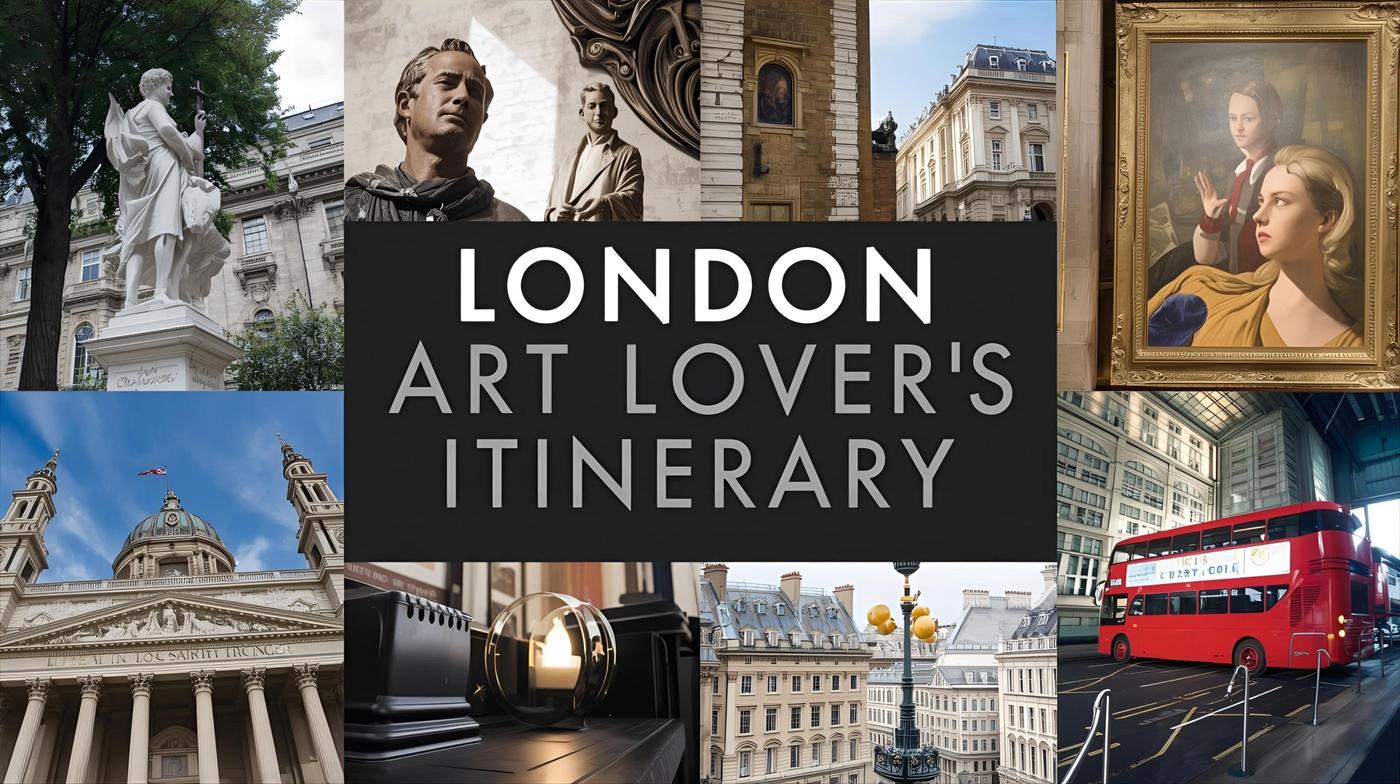
London Art Lover’s Itinerary: Dawn to Dusk in the Best Galleries
London Art Lover’s Itinerary: Dawn to Dusk in the Best Galleries
7 min read
If you are serious about building a proper London art lover's itinerary, stop winging it. We have done the ambitious version of this day more times than we can count: alarm at six, genuine discipline until about noon, and then somehow still closing down a bar at midnight having seen more art in twelve hours than most people see in a decade. London does that to you. The city has a creative density that just does not let up. You turn a corner near Covent Garden and stumble into one of the finest painting collections on Earth. You cross a bridge and walk into a former power station that became the defining institution of contemporary art. It is a lot. So we planned a full day properly, not the vague 'we'll figure it out' kind that ends in a three-hour queue and a stress headache, and we are sharing the whole route, opinions and all.
Fair warning: we have strong feelings about some of this. Not every institution here is equally good. Not every wing deserves equal time. We will tell you where to linger and where to speed-walk, and we will give you the sensory detail that makes you feel like you have actually been somewhere, not just ticked boxes.
Morning: The Weight of Human History Before 10am
Start earlier than feels reasonable. London's major institutions open at ten, and the twenty minutes before the first tour groups arrive are genuinely magical. We were at the British Museum by 9:45 on a grey Tuesday, the kind of cold, damp London morning where the air smells faintly of diesel and wet stone, and the queue was already forming but still manageable. Walk straight past the Great Court, yes it is impressive, you can admire the glass ceiling on your way out, and go directly to the Parthenon Sculptures in the Duveen Gallery. The morning light comes in at an angle that feels almost deliberate, as if the architects knew exactly what they were doing with the sun. The sculptures are quieter than the rest of the museum at this hour, and that matters, because these are not just nice friezes. These are two-and-a-half-thousand-year-old marble figures carved to sit at the very top of the Parthenon and be read like a sentence across the Athens sky. Standing in front of them with no one bumping into your elbow is a different experience entirely.
Your Key to Effortless Travel
Meet Travelfika
Planning a trip should be exciting, not exhausting—and that's where Travelfika comes in! With our smart AI-powered tools, insider tips, and seamless planning features, we make travel easier than ever.
Whether you're crafting the perfect itinerary, discovering hidden spots, or getting real-time recommendations, Travelfika has your back. No more endless research or last-minute stress—just smooth, effortless travel planning tailored to you. So go ahead, dream big, explore more, and let Travelfika handle Read More
Planning a trip should be exciting, not exhausting—and that's where Travelfika comes in! With our smart AI-powered tools, insider tips, and seamless planning features, we make travel easier than ever.
Whether you're crafting the perfect itinerary, discovering hidden spots, or getting real-time recommendations, Travelfika has your back. No more endless research—just smooth, effortless travel planning tailored to you.Read More
Planning a trip should be exciting, not exhausting—and that's where Travelfika comes in! With our smart AI-powered tools, insider tips, and seamless planning features, we make travel easier than ever.
Whether you're crafting the perfect itinerary, discovering hidden spots, or getting real-time recommendations, Travelfika has your back.Read More
Planning a trip should be exciting, not exhausting—and that's where Travelfika comes in! With our smart AI-powered tools, insider tips, and seamless planning features, we make travel easier than ever. Read More
Planning a trip should be exciting, not exhausting— and that's where Travelfika comes in! With our smart AI-powered tools, insider tips, and seamless planning features. Read More
Before the school groups descend, cut through to Room 3 for the Rosetta Stone. It is smaller than people expect, behind glass, and there is usually a brief window before 10:30 where you can get close enough to see the three scripts running in parallel: Ptolemaic Greek, Demotic, Ancient Egyptian. No backpack in your face. This is the object that cracked the code of a civilization. Take sixty seconds with it. It earns the silence.
From there, walk through Covent Garden. Grab a coffee. The streets smell of bread and yesterday's market. Arrive at the National Gallery at Trafalgar Square feeling like a person who has already done something meaningful with their morning. The National Gallery is free, enormous, and quietly one of the greatest art museums on the planet. We know that sounds like something a brochure would say, but we mean it without apology. The range is staggering, and our strong advice is this: do not try to see it all. Pick three rooms and stay in them. We always end up in Room 45 with Van Gogh's Sunflowers, which sounds obvious until you are actually in front of it and realize the brushwork is almost violent up close, urgent in a way photographs never convey. Then we cross the building to Turner's The Fighting Temeraire, a ghost of a warship being towed to the breakers in a blaze of sunset, and spend an embarrassingly long time just standing there. Room 66 has the Leonardo da Vinci cartoons, enormous preparatory drawings in chalk that feel impossibly intimate for their scale. The National Dining Rooms has decent flat whites and views over Trafalgar Square that cost nothing extra.
Midday: Power Stations, Provocations, and the Best Secret in London
Cross the Millennium Bridge after lunch on foot. Not because we are being precious about it, but because the approach to Tate Modern from the bridge, Bankside rising in front of you, that enormous chimney stack pointing at the sky, the Thames choppy and grey beneath, genuinely frames what you are about to walk into. The building was a power station until 1981 and you can still feel it. The Turbine Hall does not whisper. It echoes. Whatever installation is currently commissioned in there, and Tate Modern commissions a new one most years, you feel it in your chest before you fully see it with your eyes.
Most people cluster on the main floors and then leave. Do not do that. Take the lift to the Switch House extension, the newer pyramid-shaped tower at the back. The views of the city from the top floors alone justify the trip, and the contemporary collection up there, rougher, stranger, and more political than the main building's crowd-pleasers, is where Tate Modern really shows its teeth. The Tanks in the basement are easy to miss and genuinely worth finding: raw, unfinished concrete rooms that host performance art, film, and live work, the kind of thing that makes you feel like you are seeing something before it becomes famous.
If you have energy for a detour east, the Whitechapel Gallery in Aldgate is worth it. It is smaller, faster, and punches well above its weight. This is the gallery that gave Picasso his first major UK show and introduced Frida Kahlo to British audiences. The programming is consistently sharp and actively uncomfortable, which we mean as a compliment.
Our genuine insider recommendation, the one we give every art-obsessed friend who asks, is the Sir John Soane's Museum in Lincoln's Inn Fields. It is not a normal museum. It is the actual house of an eccentric Georgian architect who filled every room, and we mean every room, floor to ceiling, around corners, behind hinged panels in the walls, with antiquities, casts, paintings, and architectural models. It smells of old wood and cool stone and slightly of old books. Hogarth's A Rake's Progress series lives in there, behind folding wooden panels that a curator opens like a magic trick. Entry is free. The space fits about thirty people comfortably. Go on a weekday afternoon before it gets crowded and you will feel like you have discovered something that the rest of the city forgot to tell anyone about.
Afternoon: Design, Exhaustion, and the Recovery Plan
Here is something no one tells you in advance: by 2pm on an art-heavy day in London, your feet are gone. Truly gone. We have done this itinerary multiple times and learned that the afternoon needs a different energy, slower, more design-led, more about wandering than achieving. The V&A in South Kensington is perfect for this, partly because it is one of the most beautiful buildings you will ever eat lunch inside, and partly because you genuinely cannot do the V&A in one afternoon so you stop feeling guilty about not trying.
Be strategic about it. The Raphael Cartoons in Room 48a are enormous, paintings the scale of walls, preparatory designs for tapestries commissioned by Pope Leo X, and the colour in them after recent conservation is astonishing. The Fashion Gallery does that rare thing of making fashion feel genuinely historical rather than just decorative. The Cast Courts, those cathedral-like rooms full of plaster reproductions of Michelangelo's David and Trajan's Column, are the kind of place you stumble into and forget you were supposed to be somewhere else twenty minutes ago. The V&A cafe serves decent food in a room that feels more impressive than most restaurants in the city. Use it.
If your afternoon has space for Chelsea, the Saatchi Gallery is free and reliably surprising. It does not maintain a permanent collection in the traditional sense. It rotates constantly, always featuring emerging artists, always slightly confrontational, always worth at least an hour. The cafes around Sloane Square nearby are designed for exactly this moment: the mid-afternoon coffee that buys you the second wind for the evening.
Evening: The Courtauld Gallery Deserves the Last of Your Best Attention
We saved this one deliberately. The Courtauld Gallery at Somerset House is, in our collective opinion, the most underrated major art institution in the entire London art lover's itinerary. Not because the work is obscure, it is not, but because the scale of the place means you can actually look at it. You are not shuffling past Manet in a crowd twenty-deep. You are standing in front of A Bar at the Folies-Bergere with enough space to step back, then step close, then notice that the reflection in the mirror behind the barmaid does not quite add up geometrically, which is either a mistake or the whole point, depending on who you ask. Van Gogh's Self-Portrait with Bandaged Ear is here, and in person it has a rawness, the brushwork thick and almost frantic, the expression oddly calm, that reproduction never captures. Cezanne's landscapes feel like they are still being painted. The light in the galleries turns golden in the early evening and the Somerset House courtyard outside is one of the most beautiful public spaces in the city.
Cap the night at the Barbican if you have anything left. This is brutalist architecture on a scale that should not work but absolutely does, a city-within-the-city of concrete terraces and elevated walkways and arts venues that run late into the night. Check what is on before you go: there is usually a late gallery opening, a film, a concert, something crossing disciplines in the way only the Barbican does. We once ended an art day there watching an experimental film score performed live in the cinema, the kind of thing that exists nowhere else in the city. It was loud and strange and completely right for where we were by 9pm.
Getting Around Without Losing Your Mind
The itinerary above is loosely geographic. The British Museum and National Gallery sit in the centre for the morning. Tate Modern and Whitechapel are a bridge-crossing away to the south and east at midday. The V&A and Saatchi pull you west to Kensington and Chelsea in the afternoon, and the Courtauld and Barbican bring you back east towards the City for the evening. It sounds like a lot of ground but London's gallery zones are walkable or one-stop Tube rides. The Elizabeth line and the Jubilee line do most of the heavy lifting. Avoid the Central line in summer. Just trust us on that. It is not a question of distance, it is a question of not arriving at the National Gallery sweating through your shirt.
Most of the permanent collections mentioned here are free: the British Museum, National Gallery, Tate Modern, V&A, Whitechapel Gallery, and Tate Modern cost nothing on your way in. Book ahead for major temporary exhibitions, which often sell out weeks in advance, and check gallery websites for Friday and Saturday late openings. Tate Modern and the V&A both extend their hours on certain evenings with a noticeably more relaxed, adult atmosphere once the families have headed home for dinner.
The Bloomberg Connects app offers free audio tours across multiple London institutions and is genuinely useful rather than gimmicky. Download it before you leave the hotel. And talk to gallery assistants. They are more knowledgeable and more willing than most visitors give them credit for. We have gotten better recommendations from floor staff than from official guides more times than we can count.
If you want to go further off the circuit, the Photographers' Gallery near Oxford Street is small, focused, and genuinely excellent for photography treated as fine art rather than documentary. The gallery scenes in East London around Vyner Street and White Cube in Bermondsey pulse with working artists and people serious about the city's actual creative present rather than its curated past.
When you are ready to actually book this, hotels near the South Bank put you close to Tate Modern and the Courtauld, Bloomsbury puts you walking distance from the British Museum, and Kensington makes the V&A your morning coffee-run away. Travelfika can sort the logistics: flights, hotels, the neighbourhoods that make sense for the way you want to move through the city. The details are handled so you can focus on the art.
FAQs: London Art Galleries, Answered Honestly
What are the must-visit art galleries in London for a first-timer?
Anchor your day on three: the National Gallery at Trafalgar Square for the full sweep of Western painting, Tate Modern on the South Bank for contemporary and confrontational work, and the Courtauld Gallery at Somerset House for Impressionism at a human scale. Add the British Museum if you want an earlier, broader start. The Sir John Soane's Museum is our personal wildcard: free, genuinely strange, and unlike anything else in the city.
Are London's major art galleries actually free?
Yes, most permanent collections cost nothing. The British Museum, National Gallery, Tate Modern, V&A, and Whitechapel Gallery are all free to walk into on a regular day. The Courtauld charges for its permanent collection, but it is worth every penny. Major temporary exhibitions at any institution usually require a ticket and often sell out weeks ahead, so book online before you arrive.
When is the best time to visit London galleries to avoid the crowds?
Weekday mornings, right at opening time. The difference between the British Museum at 9:50am and at 11:30am is the difference between a meditative experience and a mild anxiety attack. Friday and Saturday late openings are also genuinely good:
Tate Modern and the V&A both extend their hours on select evenings
School groups are long gone by that point
The atmosphere shifts to something more social than institutional
What special art events in London are worth planning a trip around?
Frieze Art Fair in October is the biggest, two fairs in Regent's Park, and the surrounding week turns the whole city into an unofficial art event. The Royal Academy runs major summer exhibitions that sell out months ahead. The Turbine Hall commission at Tate Modern typically launches in autumn, which is worth timing a visit around if you can manage it. Always check gallery websites directly rather than aggregators for current programming.
How do you plan a full day of art in London without completely exhausting yourself?
Resist the urge to over-programme. Museum fatigue hits fast: by early afternoon your eyes start sliding off paintings that would have stopped you cold at 10am. Structure the day geographically to cut travel time, build in at least one proper sit-down break, and give yourself permission to skip entire wings of enormous museums. Seeing three things well beats seeing thirty things badly. The V&A alone could take a week.
Can families with children actually enjoy these galleries?
Absolutely, with preparation. The British Museum, V&A, and Tate Modern all run family trails and workshop programmes. Pick up the family activity packs at the entrance because they genuinely reframe the whole visit for younger visitors. The National Gallery has an app-based trail for kids that turns the collection into a scavenger hunt. Morning visits on weekdays work far better than weekend afternoons, which tend to be chaotic regardless of age.
Is photography allowed inside London galleries?
Generally yes for personal, non-flash photography in permanent collections, but it varies by room and exhibition. The practical rule: if the work is still under copyright, there is usually a no-photography sign posted. Temporary exhibitions frequently prohibit cameras entirely. When in doubt, ask a gallery assistant rather than assuming, and never use flash anywhere.