Florence in a Day: Your Perfect 5-Step Renaissance Journey
5 min read
5 Best Ways to Experience Florence in a Day
We're going to be straight with you: Florence deserves weeks. Ideally months. Possibly a whole second life dedicated entirely to standing in front of paintings and eating cured meat. But most of us don't get that. Most of us get one day, a slightly too-heavy daypack, and a phone full of screenshots from other people's Instagram accounts. We've been there — literally, on a Tuesday in late September, arguing about whether the map was upside down while a Vespa screamed past us on a street approximately the width of a hallway. This guide is built from that kind of experience.
The good news is that Florence is compact in a way that feels almost conspiratorial, like the city was designed specifically so that its greatest hits are all within a 20-minute walk of each other. The bad news is that approximately four million other people have noticed this too. Strategy, pre-booked tickets, and a willingness to be on your feet by 8am are the only things standing between you and a genuinely extraordinary day.
Start Where the City Literally Begins: The Duomo Complex
Nothing prepares you for the Duomo. You turn a corner on a narrow street, hemmed in by ochre walls and the smell of coffee drifting from a bar that's been open since before you were born, and then — there it is. The Cathedral of Santa Maria del Fiore stops you dead. Not metaphorically. We physically walked into each other the first time we came around that corner because nobody was watching where they were going. Nobody ever is.
Your Key to Effortless Travel
Meet Travelfika
Planning a trip should be exciting, not exhausting—and that's where Travelfika comes in! With our smart AI-powered tools, insider tips, and seamless planning features, we make travel easier than ever.
Whether you're crafting the perfect itinerary, discovering hidden spots, or getting real-time recommendations, Travelfika has your back. No more endless research or last-minute stress—just smooth, effortless travel planning tailored to you. So go ahead, dream big, explore more, and let Travelfika handle Read More
Planning a trip should be exciting, not exhausting—and that's where Travelfika comes in! With our smart AI-powered tools, insider tips, and seamless planning features, we make travel easier than ever.
Whether you're crafting the perfect itinerary, discovering hidden spots, or getting real-time recommendations, Travelfika has your back. No more endless research—just smooth, effortless travel planning tailored to you.Read More
Planning a trip should be exciting, not exhausting—and that's where Travelfika comes in! With our smart AI-powered tools, insider tips, and seamless planning features, we make travel easier than ever.
Whether you're crafting the perfect itinerary, discovering hidden spots, or getting real-time recommendations, Travelfika has your back.Read More
Planning a trip should be exciting, not exhausting—and that's where Travelfika comes in! With our smart AI-powered tools, insider tips, and seamless planning features, we make travel easier than ever. Read More
Planning a trip should be exciting, not exhausting— and that's where Travelfika comes in! With our smart AI-powered tools, insider tips, and seamless planning features. Read More
Brunelleschi's dome is one of those rare things that is actually as impressive as advertised. The man engineered a solution to a problem that had stumped architects for over a century, using a double-shell brick technique he largely invented as he went, and the result has dominated the Florentine skyline since 1436. Climbing it — all 463 steps of increasingly narrow, increasingly vertical spiral staircase — is an act of mild masochism that rewards you with a 360-degree view of terracotta rooftops, rolling Tuscan hills, and the very real satisfaction of having earned it with your own legs.
Book the dome climb timed-entry ticket weeks in advance. Not days — weeks. These slots vanish fast and without them you're standing outside looking up like everyone else who didn't plan ahead. Get there by 8am. The golden-hour light on the marble facade is reason enough, and the crowds that arrive by mid-morning transform the piazza into something that feels more like a airport terminal than a Renaissance masterpiece. While you're in the complex, don't skip the Baptistery — the gilded bronze doors Ghiberti spent 27 years making are so extraordinary that Michelangelo reportedly called them the Gates of Paradise, and he was not a man who handed out compliments easily.
The Uffizi: Two Hours, Maximum Respect, Zero Regrets
A five-minute walk from the Duomo — through a piazza, past a man selling terrible watercolors, and under a stone arch — brings you to the Uffizi Gallery, which contains one of the most important collections of Renaissance painting on the planet. We say this not to intimidate you but to prepare you for the very real emotional experience of turning a corner and finding yourself three feet from Botticelli's Birth of Venus with no glass between you and it.
The painting is bigger than you expect. The room smells faintly of aged wood and the particular hushed reverence that only museums and libraries produce. Primavera hangs nearby, and together the two paintings represent a moment in Western art history when human beauty and mythological imagination became the same thing. If you have even a passing interest in art, these rooms will do something to you.
Pre-book timed entry tickets — yes, we know we keep saying this, but people keep not doing it and then spending two hours in a queue that wraps around the building while the sun gets hotter. Once inside, resist the urge to see everything. The Uffizi is vast and one day is finite. Head for the second-floor galleries and let Botticelli, Leonardo, Raphael, and Michelangelo have their turn with you. Give yourself two to three hours and a willingness to just stop and look. Not photograph. Look. A guided tour focused on the key works is genuinely worth it here — the context transforms what you're seeing from beautiful shapes into actual human stories.
The Living City: Piazzas, the Ponte Vecchio, and the Bronze Pig
After the galleries, Florence asks you to put the art history away for a while and just exist in the city. The Piazza della Signoria is the place to do it. This square has been the political and civic heart of Florence for centuries, and it still carries that weight — you can feel it in the scale of the Palazzo Vecchio, in the outdoor sculpture gallery of the Loggia dei Lanzi where a Perseus holds a severed head with alarming calm, and in the replica of Michelangelo's David standing where the original stood before they sensibly moved it indoors.
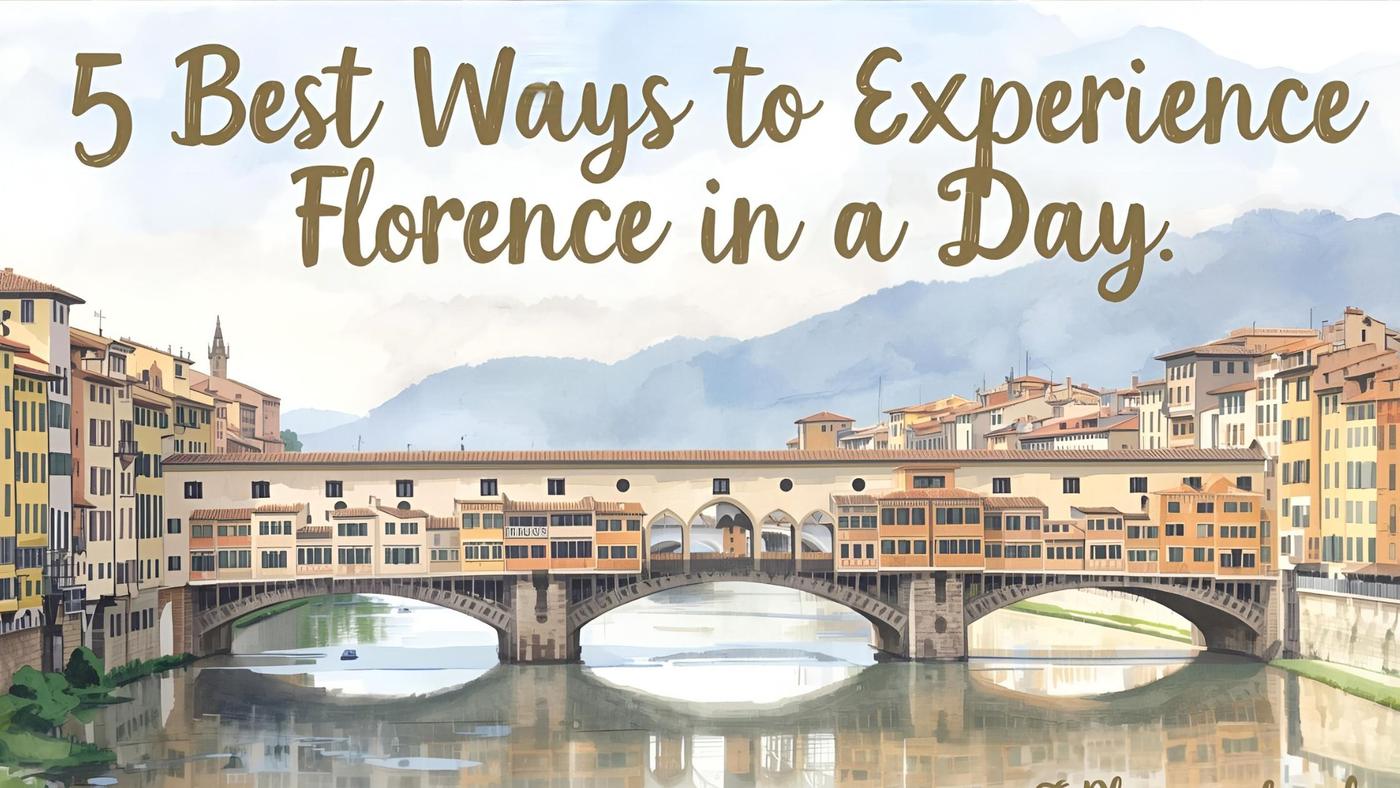
From the piazza, follow the crowds (and your nose — someone is always grilling something) south toward the Arno and the Ponte Vecchio. This bridge has been here in some form since Roman times, was rebuilt in its current incarnation in 1345, and is the only Florentine bridge the retreating German army chose not to destroy in World War II — reportedly on direct orders from Hitler, which is one of history's stranger footnotes. Today it's lined with jewelry shops that have occupied these overhanging structures since the 16th century, when the Medici kicked out the butchers (who had been there first) because they found the smell offensive on their way to the Palazzo Pitti. Power has always had opinions about smell.
Before you leave this area, find the Mercato della Paglia and locate Il Porcellino — a bronze boar whose nose has been rubbed shiny by centuries of superstitious hands, including ours. The tradition says rubbing his nose brings luck and guarantees your return to Florence. We can neither confirm nor deny the luck part, but we've all been back, so draw your own conclusions.
Eat Something Real, and Do It Properly
By now it's early afternoon, you've climbed a dome and emotionally processed several masterpieces, and you are genuinely hungry in the specific way that only sustained walking and cultural stimulation produces. This is the moment Florence's food culture becomes personal.
Step away from the piazzas — three or four blocks is enough — and find a trattoria that doesn't have a menu board with photographs or a man outside trying to hand you a flyer. In those places you will find ribollita, the Tuscan bread soup that is thicker than you expect and more satisfying than it has any right to be given its peasant origins. If you want to go further, order the bistecca alla Fiorentina — a T-bone steak the size of a small sculpture, cooked over wood fire and served rare, because the Florentines will not cook it any other way and they are correct not to. We stuffed ourselves on a two-person bistecca and a half-litre of house Chianti for less than we'd spent on airport sandwiches the morning we left home.
In the late afternoon, the aperitivo hour begins. This is when the Florentines stop whatever they're doing, sit outside with a Negroni or an Aperol Spritz, and receive a small plate of snacks with their drink as a matter of course. Join them. This is not a tourist activity — it's a genuine social ritual, and participating in it is the closest you'll get in one day to understanding how this city actually lives.
On gelato: look for colors that appear in nature. Pistachio should look like pistachio — slightly grey-green, not neon. Mango should look like a mango left in the sun, not a highlighter. The real stuff is kept in covered metal containers, not piled into theatrical mountains in the shop window. It also tastes like the thing it's supposed to taste like, which sounds obvious until you've tried both versions.
The Finale: You Have Two Good Options and Only Enough Time for One
This is where our team has argued, loudly, over dinner. The day is winding toward evening and you face a genuinely difficult decision between two experiences that are both, in their own way, exactly right.
If art is what brought you here, go to the Accademia Gallery and stand in front of Michelangelo's David. We're not going to over-explain this. The sculpture is seventeen feet of marble and it is not what you expect — not because of the nudity (though the scale of that also catches people off guard) but because of the expression. He's looking at something. He's about to do something. The tension in every muscle is so precisely observed that the stone seems to be breathing. Pre-book your timed tickets because the queue without them is a cruel joke.
If, on the other hand, your feet have made their feelings about steps very clear and you want to end the day with something expansive and quiet, climb up to Piazzale Michelangelo instead. The view from up there — the whole city laid out below you, the Duomo rising from the rooftops, the Arno catching the last light — is the image Florence puts on every postcard for a reason. Get there 30 minutes before sunset and find your spot before the crowds do. Alternatively, wander through the Boboli Gardens behind the Palazzo Pitti, a Renaissance garden that somehow still manages to feel peaceful even when it's busy, full of fountains and cypress trees and paths that seem to lead to a quieter century.
Either way, you will finish your day tired in the best possible sense — the particular heaviness that comes from having used your eyes and your legs and your appetite all at once. That's Florence working on you. Let it.
Before You Go: The Practical Stuff, Said Once
Book the Duomo dome climb, the Uffizi, and whichever finale option you choose at least four to six weeks ahead through official websites. Wear the shoes you actually walk in, not the ones you packed to look good in photographs — cobblestones are beautiful and merciless. Start at the Duomo by 8am. Carry a water bottle and refill it at Florence's public fountains, called nasoni, which are scattered through the historic center and run clean, cold water constantly. And if the idea of coordinating timed tickets across three major sites while navigating a foreign city sounds like a working holiday rather than an actual one, our Florence in a Day Tour packages the Uffizi, the Accademia, and a guided city walk with skip-the-line access into a single experience someone else has already figured out.
For more of Italy, our [Italy Tour: Rome, Venice, Florence](/italy-tours) package gives the full picture across three cities. If Rome is next on the list, the [Roman Holiday Day Tour](/rome-day-tour) applies the same logic to the Eternal City. And if you're thinking about autumn timing, our [Europe's Best Fall Destinations](/europe-fall-destinations) guide will tell you exactly why October in Tuscany is one of the better decisions a person can make.
FAQs: Florence in a Day — Answered Honestly
Can you really see Florence's highlights in just one day?
Yes, genuinely. We've done it, and we're not people who tolerate a rushed experience quietly. The key is that Florence's historic center is small — almost suspiciously so. The Duomo, the Uffizi, the Piazza della Signoria, the Ponte Vecchio, and the Accademia are all within walking distance of each other, and if you pre-book timed tickets for everything and start early, you'll cover the essential ground without spending the whole day standing in queues. More time is always better, but one well-planned day will give you the real thing, not just a highlight reel.
What's the single most important thing to book in advance?
The Duomo dome climb. Book it first, book it early — we mean weeks, not days — and treat that time slot as non-negotiable around which everything else is scheduled. The timed-entry slots for the Uffizi and the Accademia (for Michelangelo's David) are a close second and third, and both sell out faster than you'd expect for a city that's been doing tourism for five centuries. Without pre-booked tickets, you will spend a significant portion of your one day standing in lines watching other people's pre-booked days happen.
Is a guided Florence in a Day tour actually worth it for first-timers?
For most first-time visitors with one day and no prior context, yes. The skip-the-line access alone removes the single biggest source of frustration. But more than logistics, a good guide inside the Uffizi or standing in front of David changes the experience from 'looking at famous things' to 'understanding why these things are famous,' which is genuinely different. Our [Florence in a Day Tour](/florence-day-tour) covers the Uffizi, the Accademia, and a city walk with expert commentary — if the planning overhead of coordinating multiple timed sites in a foreign city sounds exhausting, let someone else carry that weight.
What do I do if the Duomo dome climb is fully booked?
First, check again — cancellations happen and slots reappear. If it's genuinely sold out, Giotto's Bell Tower on the same piazza offers comparable panoramic views over the city and typically has more availability. The Duomo Museum (Museo dell'Opera del Duomo) is also excellent and houses original artworks from the cathedral complex including Ghiberti's original Gates of Paradise panels. The cathedral interior itself is free to enter, though expect a queue — it's worth it for the frescoed dome interior alone, which you're looking up at rather than standing on top of.
What's the best way to get around Florence for the day?
Walk. Seriously, just walk. Florence's historic center is compact enough that trying to navigate buses or bike-shares between the major sites will cost you more time in confusion than it saves in steps. The cobblestones are uneven and relentless, which is why we cannot say loudly enough: wear real walking shoes. The ones you actually walk distances in, not the ones that look better in photos. Your feet will be the honest judges of this decision by 4pm.